Updated
— Pure Hair Spa · Head Spa Guide
Scalp massage benefits,
honestly.
Search this phrase and you will be told a scalp massage regrows hair, detoxifies your follicles and rebalances your nervous system. Two of those are marketing. This is what a scalp massage genuinely does, what the published research supports, what it cannot do, and how to get most of the benefit at home for free.
15–20 min inside every ritual · 5 min at home · $99 first visit · 4.6★, 170+ reviews
Written and reviewed by the Pure Hair Spa scalp team — licensed scalp therapists at Mountain View's dedicated scalp studio, open since 2021 and rated 4.6★ across 170+ Google reviews.
On this page
- What a scalp massage actually is.
- The benefits that hold up.
- What the research does and does not say.
- Head massage and scalp massage.
- In a studio versus on your sofa.
- How to do it at home.
- Dry scalp, oily scalp, and everything between.
- When a massage is not the answer.
- Where it sits inside a head spa.
— Start here
What a scalp massage
actually is.
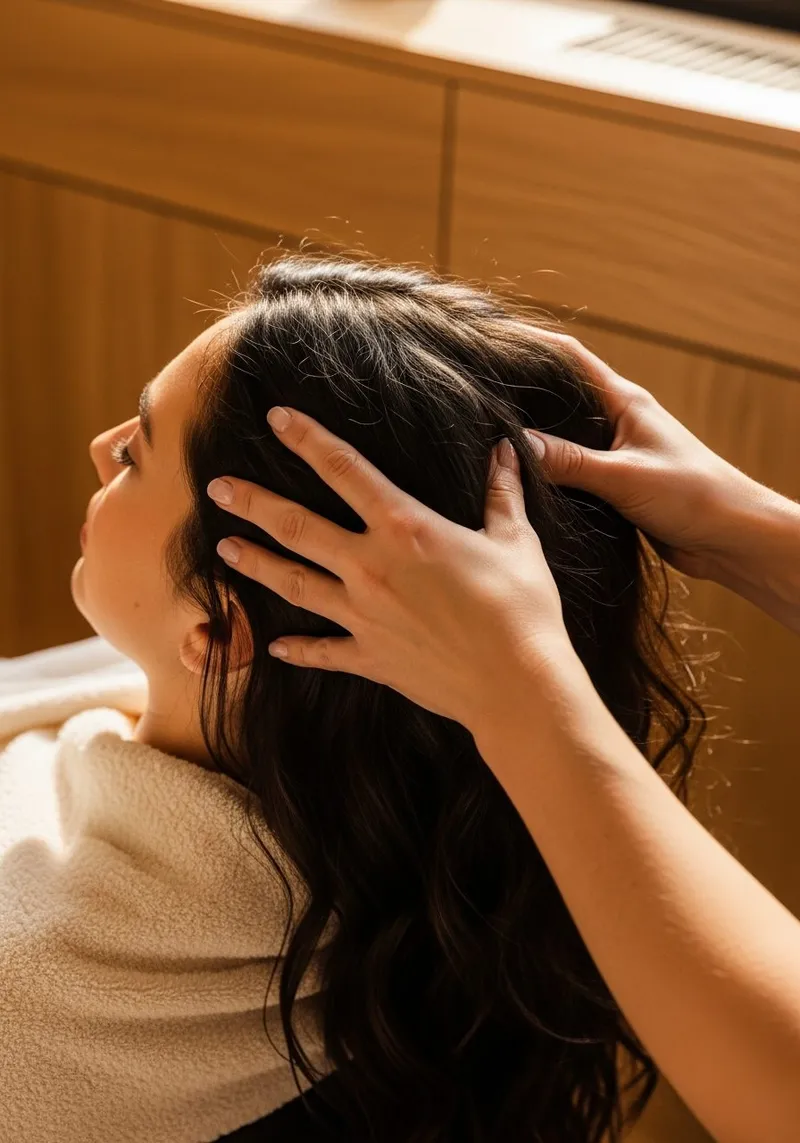
A scalp massage is fingertip pressure applied to the scalp and to the thin sheet of muscle and connective tissue underneath it, held and released rather than rubbed. The distinction matters: rubbing moves hair and irritates skin, while sustained pressure moves the tissue over the skull, which is where the effect comes from.
The scalp sits on the galea aponeurotica — a tough fibrous sheet connecting the muscles at your forehead to the ones at the base of your skull. When you clench your jaw at a screen for eight hours, that sheet tightens along its whole length. A scalp massage is one of the few ways to reach it directly.
That anatomy explains why a good scalp massage is felt in the neck and shoulders rather than only on top of the head, and why the sequence in a professional head spa starts at the occipital ridge instead of the crown. It also explains why five minutes of distracted rubbing does very little.
Duration is the other variable people underestimate. Most benefits reported in both clinical work and our own guest feedback come from sustained sessions — the 15 to 20 minutes built into a head spa, or a consistent daily few minutes at home — rather than from an occasional vigorous minute in the shower.
— The real list
The benefits that
hold up.
Stripping out everything unsupported, four benefits survive scrutiny. These are the ones we are comfortable stating to a guest before they pay.
- Tension release in the head, neck and jaw. The most reliable effect by a wide margin. Guests who book a head spa for their scalp routinely comment on their shoulders instead, and the occipital and trapezius work is why.
- Measurable relaxation. A long scalp massage produces the same downshift as any sustained slow-pressure bodywork. It is common enough for guests to fall asleep at the basin that we plan the schedule around it.
- Better cleansing outcomes. Fingertip work during a wash physically loosens sebum and product from around follicle openings. This is mechanical, not mystical, and it is the reason the massage in a head spa is interleaved with the cleanse rather than added at the end.
- Short-term scalp comfort. A tight, dry-feeling scalp usually feels better afterwards — partly from tension release, partly because a massage distributes the natural oil film more evenly across the surface.
— The uncomfortable part
What the research
does and does not say.
This is where most pages on this topic quietly overreach, so we will be specific. The claim that scalp massage grows hair rests on a small body of preliminary work — most often cited is a 2016 Japanese study in which a handful of men performed several minutes of standardised daily scalp massage over 24 weeks and showed increased hair thickness, and a later self-reported survey of people with androgenetic alopecia.
These are small, short and largely uncontrolled. They are enough to make the idea plausible and nowhere near enough to make it a promise. If you want to read the field yourself rather than take our word for it, the PubMed literature on scalp massage and hair growth is open and short enough to skim in an evening.
The mechanism people propose — mechanical stretching of dermal papilla cells altering gene expression — is a real hypothesis with real cell-level support. It is not the same thing as a demonstrated clinical outcome in a normal population.
Here is every claim you will see attached to scalp massage, sorted by how much weight it can actually carry. We would rather you booked knowing which row you are buying.
| Claim | What supports it | How strong | Our position |
|---|---|---|---|
| Releases head, neck and jaw tension | Consistent with all sustained slow-pressure bodywork; near-universal guest report | Strong | We state this without qualification |
| Produces measurable relaxation | Well-established for massage generally; guests routinely fall asleep mid-session | Strong | We state this without qualification |
| Improves cleansing around follicles | Mechanical — fingertip pressure loosens sebum and product during a wash | Strong | This is why massage is interleaved with the cleanse, not added after |
| Increases local blood flow | Physiologically expected from sustained pressure; short-lived | Moderate | True, but the effect ends roughly when the massage does |
| Increases hair thickness over months | One small Japanese trial of standardised daily massage over 24 weeks, plus a self-reported survey | Weak / preliminary | Plausible, unproven. We will not promise it |
| Detoxifies the scalp | Nothing. Skin does not detoxify in response to pressure | None | We do not make this claim |
| Cures dandruff | Nothing. Dandruff responds to antifungal actives and contact time | None | Massage helps the product reach the skin; it is not the treatment |
If a studio's marketing leans on the bottom two rows, that tells you what kind of studio it is. Everything in the top three rows is available at any competent head spa.
What we tell guests about hair growth
That scalp massage supports the environment hair grows from, and that this is a genuinely different sentence from "it grows hair".
For diagnosed hair loss, the treatments with real evidence behind them are medical. The American Academy of Dermatology lays out what actually works, and scalp work belongs alongside that plan rather than instead of it.
Claims we will not make
That massage detoxifies the scalp — detox is not a thing skin does in response to pressure. Cleansing removes buildup; massage helps the cleanser reach it.
That it reverses greying, cures dandruff or thickens hair permanently. Dandruff responds to antifungal actives and consistent contact time, not to hands.
— Two words, one service
Head massage and
scalp massage.
People search both phrases and mean slightly different things by them, so it is worth separating. A head massage in the Indian champissage tradition covers the head, neck, shoulders and upper arms, often with oil, and is framed as bodywork. A scalp massage in the Japanese head spa tradition is narrower and skin-focused — it happens during a cleanse, with water, aimed at the scalp as skin rather than at the muscles as tension.
In practice the two overlap almost completely. Our sequence uses the Japanese structure but includes the shoulder and trapezius work that the champissage tradition treats as central, because guests arrive with desk tension whether or not they came for it.
The distinction that actually matters when booking is not the name but the water. A dry head massage over your hair is bodywork and can be excellent. A scalp massage inside a wash is skin work. If your complaint is buildup, flaking or oil, you need the wet one — and the stage-by-stage head spa walkthrough shows where it sits in the sequence.
— Honest comparison
In a studio versus
on your sofa.
A professional scalp massage is better than a home one in specific, nameable ways — and worse in one important way, which is that it happens once a month instead of daily. Both have a place, and we would rather you did both than neither.
| In a head spa | At home | |
|---|---|---|
| Duration | 15–20 min structured sequence | 2–5 min, realistically |
| Frequency | Monthly for most guests | Daily, if you build the habit |
| Pressure | Consistent; someone else's hands do not tire | Fades after about 90 seconds |
| Combined with cleansing | Yes — interleaved with a double cleanse | Only during your own shampoo |
| Reaches the occipital ridge | Yes, properly | Awkward angle; most people skip it |
| Cost | From $99 first visit, $80–$199 after | Free |
The best outcome we see is guests who do both: a monthly ritual for the cleanse and the full sequence, plus a few minutes most evenings to keep the tension from rebuilding.
— Free version
How to do it
at home.
This is the sequence we teach guests at the end of an appointment. It takes about five minutes, it costs nothing, and done most evenings it holds a surprising amount of the benefit between visits.
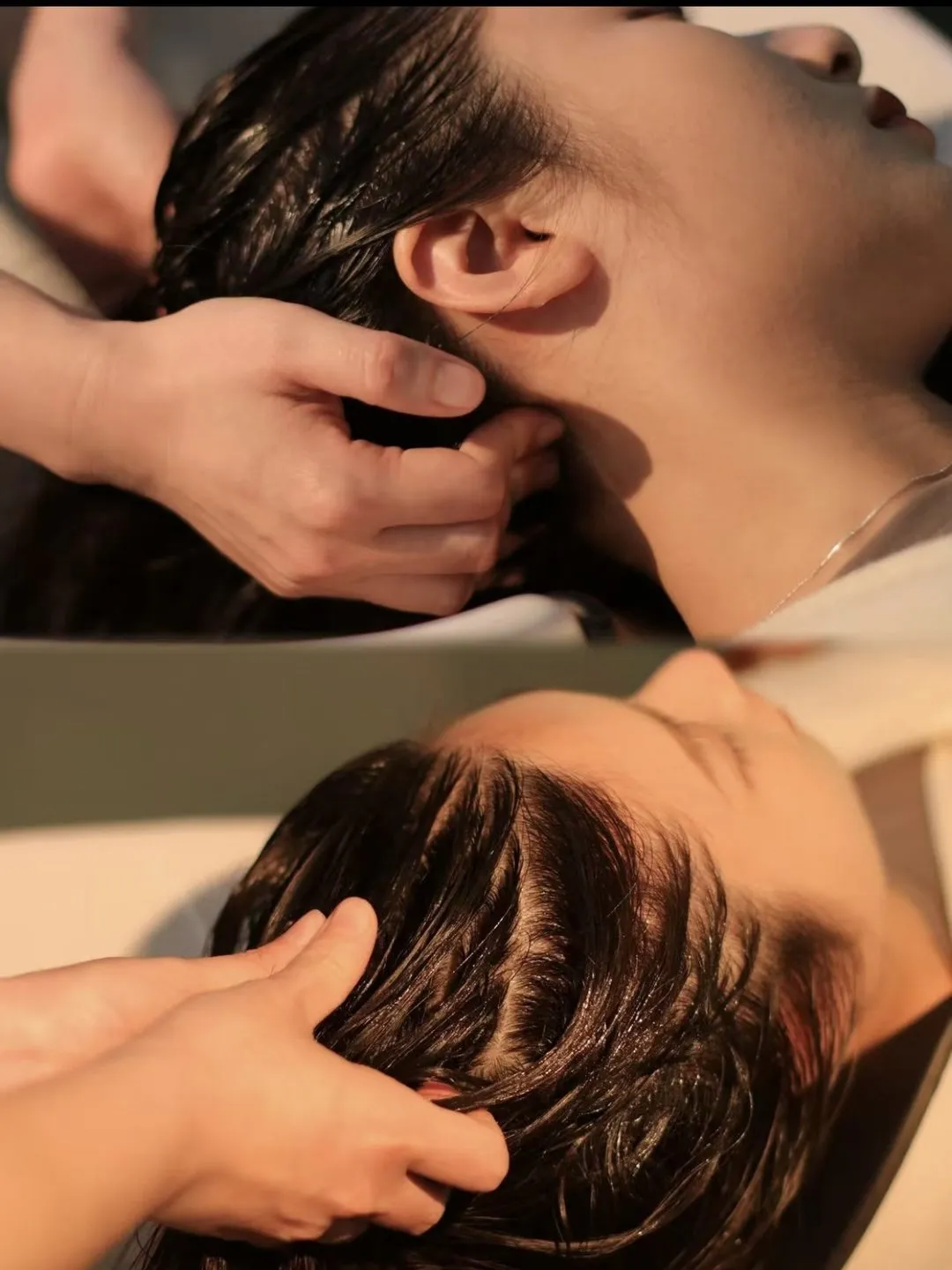
- 01 Start at the base of the skull. Find the ridge of bone where your neck meets your head. Place both thumbs just below it and press upward into the muscle. Hold for ten seconds, release, move half an inch outward. Repeat across the whole ridge — this is where the tension actually lives.
- 02 Work the sides with flat fingertips. Above the ears, press the pads of four fingers into the scalp and move the skin over the skull in small circles. You are moving tissue, not hair. If hair is sliding under your fingers, you are rubbing instead of pressing.
- 03 Cross the crown in lines. Walk your fingertips from the hairline back to the crown in parallel rows, pressing and releasing every inch. Cover the whole top of the head twice.
- 04 Finish at the temples and hairline. Slow circles at the temples, then press along the front hairline with your thumbs. Most jaw-clenching tension surfaces here.
- 05 Do it dry, or during shampoo. Dry is better for tension. During shampoo is better for buildup — the same pressure with cleanser present is what makes a wash actually clean the scalp rather than the hair.
— Scalp type matters
Dry scalp, oily scalp,
and everything between.
The same massage suits different scalps differently, and the adjustments are simple enough to make yourself.
Dry scalp massage
A dry, tight-feeling scalp benefits from slower pressure and fewer passes. Aggressive work on already-compromised skin makes flaking worse rather than better.
A few drops of a light oil applied before a dry massage helps, left on for twenty minutes and shampooed out. If flaking is persistent and greasy-yellow rather than dry and white, that pattern is worth reading about on NIH MedlinePlus before treating it as dryness.
Oily scalp massage
An oily scalp does best with massage during the wash rather than dry. Dry massage on an oily scalp distributes sebum down the lengths, which is why hair can look greasier after.
Two cleanses with firm fingertip work through both is the pattern that breaks the wash-more-get-oilier cycle. It is exactly what the first two stages of our ritual do.
Sensitive or reactive scalp
Drop the pressure and remove fragrance. Reactive scalps respond to gentle sustained contact and react badly to friction.
Tell your therapist in the first two minutes rather than enduring it — the whole sequence adapts easily.
Thinning or shedding
Use fingertips only, never nails, and avoid dragging. Hair in a shedding phase comes out under friction that healthy hair tolerates.
This is the case where professional work earns its price: our 90-minute ritual pairs the massage with a growth serum and LED red infrared light.
— Know the edge
When a massage
is not the answer.
Scalp massage is low-risk, which makes it easy to over-apply to problems it does not solve. Four situations where something else is needed first.
Active dandruff with itch and redness. This responds to antifungal actives with real contact time. Massage helps the product reach the skin; it does not replace the product. Our 75-minute Anti-Dandruff ritual is built around that order of operations.
Sudden or patchy hair loss. Hair coming out in defined patches, or a noticeable change over weeks rather than months, is a dermatologist appointment. Do not spend three months massaging first.
Anything painful, weeping or spreading. Sores, scabs and painful areas are medical. We will happily work around a settled patch, but we will say plainly when something belongs elsewhere.
Recent scalp procedures or transplants. Follow your surgeon's timeline, not a spa's. Bring the instructions and we will work to them.
— The professional version
Where it sits inside
a head spa.
Every ritual on our menu contains the same 15 to 20-minute structured scalp massage — it is the spine of the service, not an upgrade. The tiers differ in what is layered around it: exfoliation and a mask at 75 minutes, a growth serum and LED red infrared light at 90.
That means the cheapest way to experience a full professional scalp massage here is the 60-minute Basic Cleanse at the first-visit rate of $99, and that at a ten-session package rate the same seat is $80. Booking up a tier buys extra treatment stages, not extra hands.
| Ritual | Massage time | Single | First visit |
|---|---|---|---|
| 60 min · Basic Cleanse | 15–20 min + shoulders | $199 | $99 |
| 75 min · Anti-Dandruff | 15–20 min + extended shoulders | $279 | $139 |
| 90 min · Anti-Aging & Hair Growth | 20–25 min + extended shoulders | $399 | $219 |
Every tier is performed by a licensed scalp therapist and finishes with a hand-blown dry. Full inclusions are on the <a href="/scalp-treatment">scalp treatment menu</a>.
— Straight answers
Asked at
the front desk.
The questions guests actually ask before their first booking on Villa Street — answered without a sales pitch. Still unsure? Call (650) 386-6904.
Does scalp massage really help hair growth? +
The honest answer is: possibly, modestly, and the evidence is preliminary. A small 2016 Japanese study of standardised daily scalp massage over 24 weeks found increased hair thickness, and cell-level work supports a plausible mechanism. Those are small and short studies, not a basis for a promise. Scalp massage supports the environment hair grows from; it is not a treatment for diagnosed hair loss.
How long should a scalp massage be? +
At home, four to five minutes done consistently beats fifteen minutes done occasionally — the studies showing any effect used short daily sessions over months. In a professional setting, 15 to 20 minutes is the standard inside a head spa, extending to 25 on our 90-minute ritual.
Is a head massage the same as a scalp massage? +
Nearly. A head massage in the Indian tradition covers head, neck, shoulders and arms, usually dry and with oil. A scalp massage in the Japanese head spa tradition is narrower and happens during a cleanse, treating the scalp as skin. Our sequence uses the Japanese structure and keeps the shoulder work from the other.
Should I do a scalp massage on dry hair or during shampoo? +
Both, for different reasons. Dry massage is better for tension release. Massage during shampoo is better for buildup, because the pressure helps the cleanser reach around the follicle openings. If your scalp is oily, favour the shampoo version — dry massage on an oily scalp spreads sebum down the lengths.
Can scalp massage make hair fall out? +
Friction can pull out hair that was already in its shedding phase, which is why fingertips rather than nails matter and why dragging through tangles is a bad idea. It does not cause hair loss. If you are seeing noticeably more hair than usual, that is worth a dermatologist rather than a change in technique.
Is scalp massage good for a dry, flaky scalp? +
Gentle massage helps a dry scalp feel more comfortable and distributes natural oils more evenly, but pressure alone will not fix flaking. Slow it down, drop the intensity and pair it with hydration rather than exfoliation. Greasy-yellow flaking with redness is a different condition from dryness and deserves a proper look.
How often should I get a professional scalp massage? +
Monthly suits most guests as maintenance. If you are working on a specific concern, a short course of three to ten sessions one to two weeks apart does considerably more, and package pricing brings the per-session cost down to $80 to $150 depending on tier.
Do I need to book a whole head spa just for the massage? +
The massage is not sold separately here, because it is interleaved with the cleanse rather than bolted on. The lowest-cost way to get the full structured sequence is the 60-minute Basic Cleanse at the $99 first-visit rate. Call (650) 386-6904 if you want to talk through which tier fits before booking.
— Where to go next
Keep reading, or come sit down.
- Open
Guide
What happens during a head spa
Where the massage sits in the five-stage sequence, minute by minute.
- Open
Guide
Is a head spa worth it?
The full price ladder and the per-session package math.
- Open
Service menu
Scalp treatment menu
All three rituals, every inclusion, every package rate.
- Open
City page
Anti-dandruff treatment
The 75-minute ritual built for flaking, itch and irritation.
— Continue exploring
Related guides & city pages.
- Read page
Long-tail page
Mountain View Spa Guide
The full local map — competitors, keywords, internal architecture.
- Read page
Long-tail page
Japanese Head Spa · Mountain View
The slow Japanese-style scalp ritual — 60 / 75 / 90 min.
- Read page
Long-tail page
Anti-Dandruff Treatment · Mountain View
Salon-grade flake / itch / irritation reset.
- Read page
Long-tail page
Gel Manicure · Mountain View
Six gel tiers, zero acrylic. Cat-eye finishes included.
- Read page
Long-tail page
Eyelash Extensions · Mountain View
Custom-mapped Classic, Hybrid, 6D Volume and Lash Lift.
- Read page
Long-tail page
Pedicure · Mountain View
Gel-only pedicures $35–$105, cat-eye finishes, zero acrylic.
- Read page
Long-tail page
Lash Lift · Mountain View
Keratin lift for your own lashes — $129, lasts 6–8 weeks.
- Read page
Long-tail page
Scalp Treatment · near Palo Alto
12 minutes from University Ave — rituals from $99 first visit.
- Read page
Long-tail page
Head Spa · near Sunnyvale
The dedicated Japanese head spa one town over.
- Read page
Long-tail page
Head Spa · Bay Area Guide
What a real head spa includes, costs and where to get one.
— Understand it first
The head spa guides.
- Read guide
Guide
Head Spa Guide
The category explained — five stages, the vocabulary and the full price ladder.
- Read guide
Guide
What Happens During a Head Spa
Stage by stage, with a minute-by-minute timing table.
- Read guide
Guide
Is a Head Spa Worth It?
The $99–$399 ladder, the package math, and when to skip it.
— Or jump straight to